Horror Sandbox: Sprank Monster
- 3.2
- Rating
- 1.00M
- Installs
- Free
- Price

 Analysis by App-foxy
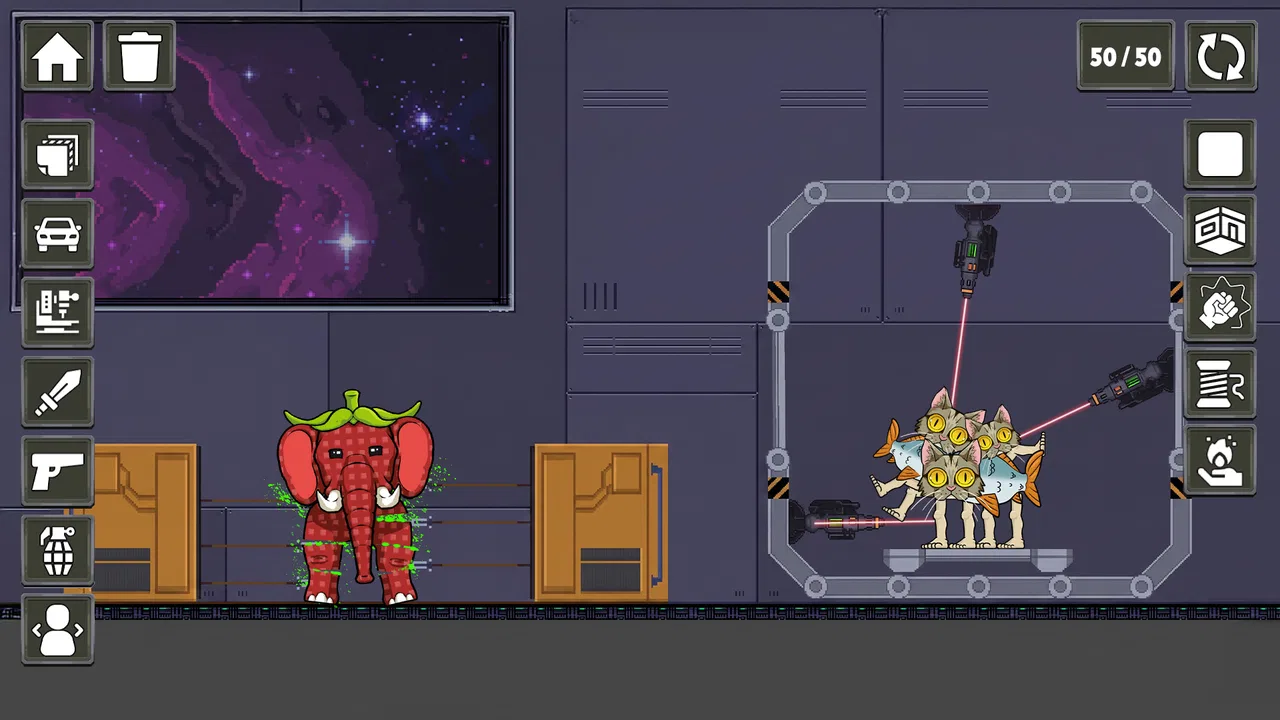
I approached Horror Sandbox: Sprank Monster expecting a compact action game built around experimentation rather than a traditional campaign. That first impression is important, because this is not the kind of horror game I would choose for a carefully scripted story, tense exploration, or a long list of objectives. Its appeal comes from giving me a disturbing playground and letting me decide how to use it. The store summary describes the idea as tormenting ragdolls creatively, and that captures the unusual tone: the game mixes horror imagery with sandbox-style play, so curiosity matters as much as reflexes.
It is a free game from Isandares, with optional in-app purchases ranging from $0.99 to $29.99 per item. It is listed for Teen audiences, and it runs on devices using Android 7.0 or later. Those details make it fairly accessible to try, but the age rating is worth taking seriously because the central fantasy is built around frightening creatures, physical reactions, and deliberately unpleasant experimentation. I would not hand it to a young child simply because it is free or visually simple.
What the opening hours actually give you
The first useful goal is not “finish a chapter” in the usual action-game sense. My early objective was to understand what the sandbox allowed, identify which interactions produced the most entertaining reactions, and learn how much freedom the scene gave me. That makes the opening feel more like testing a toy box than following a mission briefing. Players who enjoy discovering possibilities for themselves will settle in quickly; players who need a clear marker telling them exactly what to do may feel directionless.
You May Also Like

 Blood Strike: 2.5 Anniversary
Blood Strike’s Loadouts Turn Every Drop Into a Tactical Gamble
A close look at Blood Strike’s custom loadouts: how fast access to signature weapons reshapes its battle royale rhythm, rewards preparation, and narrows the gap between fights.

 Pandora - Music & Podcasts
Pandora’s Music Is Easy to Start, but Harder to Recover
Pandora’s strength is its low-effort path from a seed to a station. Its weak spot is how much confidence it asks you to place in connection, setup, and quiet recovery.

 8 Ball Pool
 Is Built on Rivalries, Rematches, and Routine
A close look at the rivalries, rematches, shared routines, and unanswered safety questions that turn a quick pool match into a persistent mobile community.

 Samsung Music
’s Quiet Strength Is Playing What You Already Own
Its reach comes less from spectacle than from dependable access to a personal library. That simplicity is both the app’s strongest retention engine and its ceiling.

 AccuWeather: Weather Radar
AccuWeather Review: A Quick, Clear Forecast for Everyday Decisions
For everyday plans, the best forecast is the one you can understand quickly. AccuWeather makes rain timing, radar, and local conditions easy to act on, with a few trade-offs.

 Hill Climb Racing
Why Hill Climb Racing Still Turns Crashes Into One More Run
A tiny car, a bumpy hill and one more upgrade: Hill Climb Racing keeps resurfacing because its simple chaos makes every near-miss feel personal.
More From Our News Desk
View All News


That lack of a conventional opening structure is both the game's identity and its first limitation. In a standard horror action title, the first few minutes usually teach movement, establish a threat, and point toward the next room. Here, the motivation is more personal: I create a small experiment, observe the result, and then try to make the next one more interesting. The reward is the outcome itself. This can be surprisingly engaging when I am in the mood to tinker, but it does not provide the same immediate purpose as a mission-based game.
I found it helpful to begin with controlled tests rather than trying to make the most chaotic scene immediately. I would change one element, watch the ragdoll response, and then repeat the setup with a different approach. That simple habit makes the game easier to read. If everything is altered at once, it becomes difficult to understand why a result happened, and the sandbox can feel random even when the interaction is behaving consistently.
The strongest early goal is learning the rules of the playground, not chasing a traditional victory screen. That distinction should guide your expectations before downloading it. If you want a quick horror distraction where you can create strange situations without committing to a long story, the opening has a clear purpose. If you want a dramatic introduction with named characters and escalating plot stakes, this is the wrong starting point.
Finding a personal reason to keep experimenting
Because the game is built around creative torment, the player supplies much of the motivation. I kept playing when I set myself small challenges: produce a more elaborate scene, find a different way to trigger a reaction, or recreate a setup that looked funny rather than merely violent. These are self-imposed goals, but they give the sandbox shape. Without them, the experience can become a short novelty that I open, test, and abandon.
A practical use case is a brief break when I want something interactive but do not want to follow a story. I can spend a few minutes arranging an experiment, observe the result, and stop without worrying about losing campaign progress. That makes the game more flexible than a conventional horror adventure. At the same time, it means the experience depends heavily on my mood. On a tired day, I may prefer a game that tells me what to do instead of asking me to invent a reason to continue.
The horror presentation also changes how long I want to play. The unsettling theme can make a short session memorable, but repeated exposure to the same kind of disturbing spectacle may reduce its impact. I would treat it as a game for occasional experiments rather than an automatic daily routine. That is not necessarily a flaw; sandbox games often work best when I return with a new idea instead of grinding through identical tasks.
Progress, challenge, and the rhythm of a sandbox
Before settling into the game’s open-ended loop, I’d think about what makes a sandbox session satisfying when a device is shared: a clear personal goal and a natural stopping point. I find that treating each attempt as a small experiment makes it easier to enjoy the results without turning casual play into an endless turn-taking session. That also sets up a useful question: how much structure should I bring myself?
How progress feels when there is no obvious campaign ladder
The clearest progress signal is my own growing understanding. At the beginning, I am simply seeing what happens. Later, I start planning the setup before acting, predicting how the ragdoll might respond, and refining the scene when the first attempt looks flat. That change from random poking to deliberate construction is meaningful, even though it is not the same as unlocking a new chapter or improving a character sheet.
This kind of progress will appeal to players who measure improvement through creativity and control. I can look back at an early experiment and recognize that I now understand how to make a more effective or more visually interesting scenario. The trade-off is that the game may offer less reassurance to players who expect visible milestones. If you need a steady stream of badges, levels, equipment, or story revelations, the sandbox format may feel thin.
I also paid attention to whether the game encouraged a repeatable loop. The basic rhythm is straightforward: enter the horror sandbox, arrange or initiate an interaction, watch the physical result, then adjust the next attempt. That loop is easy to grasp, which is good for casual play. Its longevity depends on how many meaningful variations I can imagine and how satisfying the reactions remain after the novelty fades.
One useful approach is to separate experimentation into themes. I might spend one session focusing on positioning, another on timing, and another on creating a scene that looks absurd rather than frightening. This avoids repeating the same action with no purpose. It also reveals whether I genuinely enjoy the underlying sandbox or was only entertained by the first surprise.
Challenge without turning the game into a conventional action test
The challenge here is less about mastering a difficult enemy pattern and more about making the environment work for me. That can be refreshing because failure is not always a hard stop. A failed setup can still be informative: perhaps the timing was poor, the arrangement was too simple, or the result lacked the visual impact I expected. I can reset mentally and try again without treating every mistake as wasted time.
However, this softer form of challenge may not satisfy someone looking for demanding combat. The game belongs to the action category, but I would not compare its challenge directly with a reflex-heavy arena game or a horror title built around survival pressure. Its action comes through interaction and spectacle. Players who want precise dodging, resource management, and enemy strategy should look at a more traditional alternative.
The difficulty curve therefore feels personal. A newcomer may find the controls and basic interaction easy to understand, while a creative player can make the experience more demanding by setting stricter goals. For example, I can try to build a scene with fewer adjustments, create a more controlled sequence, or aim for a particular visual outcome. These are not the same as official difficulty settings, but they give experienced players a way to add friction when the basic loop becomes familiar.
That flexibility is one of the game's better design qualities. It prevents the experience from forcing every player into the same pace. The downside is that self-directed difficulty requires discipline. If I do not create my own boundaries, the game can feel like it has stopped developing even when I have simply stopped asking new questions of it.
What keeps the pacing alive, and what weakens it
The pacing works best in short bursts. A successful experiment creates a small payoff, and I can immediately attempt a variation while the result is still fresh. There is little need for a long warm-up, so the game can fit into a spare moment. This is a stronger fit for mobile play than a slow, story-heavy horror adventure that expects uninterrupted attention.
The same compact rhythm can become repetitive. When each session follows the same pattern and I am not pursuing a new personal challenge, the sense of discovery drops quickly. The horror theme may attract me initially, but atmosphere alone cannot carry an open-ended sandbox forever. I need either new ideas of my own or enough meaningful variation in the available interactions to keep the loop from becoming mechanical.
For that reason, I would avoid judging the game solely by the first few minutes. The better question is whether you enjoy setting up experiments. If you do, the pacing can feel relaxed and self-directed. If you are waiting for the game to introduce a major twist, a new objective, or a dramatic escalation at regular intervals, you may decide that the rhythm is too flat.
Another practical tip is to stop after a satisfying result instead of continuing until the experience feels stale. Sandbox games often lose their charm when I keep repeating an idea after I have already seen its best version. Returning later with a different goal preserves more of the novelty than forcing a long session.
Retention pressure and the role of optional spending
The game is free to download, which lowers the barrier to trying its unusual concept. Its optional purchases are priced from $0.99 to $29.99 per item, so I would pay attention to how comfortable I am with the available free experience before considering any spending. A free entry point is useful here because the sandbox format is highly personal: some players will immediately enjoy the creative loop, while others will discover that the lack of structured progression is not for them.
I would not install it expecting a conventional long-term progression plan simply because it is an action game. The main retention pressure comes from curiosity and the desire to produce a better or stranger scenario. That can be healthier than a loop that pushes me to return only to maintain a streak, but it also means the game has to keep giving my imagination room to work.
My advice is to treat purchases as a separate decision from the initial download. First, spend enough time learning the basic loop and ask whether you are still inventing new experiments after the initial novelty. If the answer is no, extra spending is unlikely to fix the underlying mismatch. If the answer is yes, then the game has already demonstrated its value to you before money enters the decision.
This is also where the Teen rating matters in practical terms. The content is not a neutral physics toy; the horror framing and torment-focused premise are central to the experience. I would avoid playing it around children or recommending it to someone who dislikes graphic or unsettling themes, even if that person normally enjoys casual sandbox games.
Who should choose this over a usual horror action game?
I would recommend it to players who like ragdoll experimentation, dark humor, and open-ended interaction more than narrative tension. It is especially suitable for someone who wants a mobile game that can be opened for a short session without remembering a complicated plot. The developer, Isandares, has positioned the experience around a focused idea rather than a broad genre package, and that focus is easy to understand once I stop expecting a conventional campaign.
It is less suitable for players who want stealth, exploration, a carefully paced story, or a strong sense of character development. A standard survival-horror game is the better choice if your favorite moments come from conserving resources, escaping a persistent threat, and uncovering a mystery. A physics sandbox without horror may be preferable if you enjoy experimenting but do not want the disturbing presentation. A competitive action game is a better fit if your motivation comes from opponents, rankings, or precise skill tests.
There is also a difference between watching a funny ragdoll result and actively creating one. If you only want quick spectacle, a short video or a more automated game may deliver that faster. The appeal here is the small amount of authorship: I decide what to try, notice what worked, and shape the next attempt. That makes the experience more rewarding for curious players than for passive ones.
Device expectations and practical first-session advice
The minimum operating-system requirement is Android 7.0, so the game is not restricted to only the newest Android phones. Even so, I would approach the first session with realistic expectations about mobile comfort. Physics-heavy scenes can become visually busy, and a small screen makes careful setup less convenient than it would be on a larger display. I found that simple arrangements are easier to understand than overcrowded ones, especially when I am still learning how the game presents cause and effect.
My preferred first session would be short and deliberate. I would begin by exploring one interaction at a time, then repeat it with a small change. After that, I would try to create a complete scene with a clear beginning and result. This workflow tells me more than rushing through several random attempts, because it shows whether the game rewards planning or only produces momentary chaos.
I would also judge the game on how comfortable it feels to reset and retry. A sandbox needs a low-friction loop: if restarting an experiment feels cumbersome, the creative idea loses momentum. When the process is easy, even an unsuccessful attempt can become part of the fun. That is the difference between a toy I revisit and a novelty I uninstall after one evening.
My progression verdict after weighing the whole loop
Horror Sandbox: Sprank Monster succeeds when I treat progression as improved experimentation rather than a ladder of formal unlocks. Its early goals are self-created, its progress signals come from better control and more inventive setups, and its difficulty rises mainly through the standards I set for myself. That structure is honest about what the game is, but it will not satisfy everyone.
The average rating is 3.1 from around 1.3 thousand ratings, while the game has passed one million installs. I read that combination as a sign that the concept reaches a broad audience but produces divided reactions. That makes sense to me: the premise is distinctive, yet the same open-ended design that attracts sandbox fans can frustrate players who expect a clear campaign and stronger progression.
The current version is 1.4.8, and the game was released on December 10, 2024. Those details place it as a relatively recent entry rather than an old mobile staple, but I would still evaluate it by the loop available today: does creating and refining horror-themed ragdoll scenes remain enjoyable after the first surprise? For me, the answer is yes in short sessions, provided I bring a specific idea instead of waiting for the game to supply all the momentum.
My final recommendation is therefore selective. Try it if you want a free, strange action sandbox and enjoy discovering your own objectives. Skip it if you need story, competitive challenge, or a predictable chain of unlocks. I would keep it installed as an occasional creative distraction, not as my main horror game. Its best quality is the freedom to turn a simple setup into something unexpectedly entertaining; its biggest weakness is that the same freedom can leave the experience feeling empty when my curiosity runs out.
FAQs for Horror Sandbox: Sprank Monster
01What is Horror Sandbox: Sprank Monster?
Horror Sandbox: Sprank Monster is a creative horror-themed sandbox game where you can experiment with eerie characters, unusual environments, and interactive objects. Rather than following one fixed storyline, the experience focuses on exploration and playful experimentation. You can arrange monsters, test different combinations, and create strange scenes while discovering how the game’s elements react to one another.
02Is Horror Sandbox: Sprank Monster suitable for children?
The game’s simple sandbox mechanics may be easy for younger players to understand, but its horror presentation is not necessarily suitable for every child. Expect creepy monster designs, unsettling environments, suspenseful moments, and possibly frightening sound effects. Parents should check the screenshots, store rating, and content description before allowing children to play, especially if they are sensitive to scary imagery.
03Does the game require an internet connection?
Horror Sandbox: Sprank Monster may offer much of its core sandbox gameplay offline, which is convenient when you want to experiment without mobile data or Wi-Fi. However, certain features can depend on the version installed, including advertisements, updates, online content, or optional downloads. It is best to launch the game once while connected, then test which features remain available offline.
04Is Horror Sandbox: Sprank Monster free to download and play?
The game can generally be downloaded without an upfront purchase, but free access does not always mean that every feature is completely unrestricted. Depending on the platform and version, you may encounter advertisements, optional purchases, locked content, or prompts to support development. Review the official store listing carefully before installing, particularly if the device is used by children.
05What devices are compatible with Horror Sandbox: Sprank Monster?
Compatibility depends on whether you are using the Android or iOS version, as well as the operating system requirements specified by the developer. Older phones may install the game but deliver slower loading, reduced performance, or occasional stuttering when many objects appear on screen. Before downloading, check the official store page for supported versions, required storage, and available device information.
Pros
- Creative sandbox lets you build unusual horror scenes freely.
- Distinct monster designs create a memorable visual style.
- Simple controls make experimenting easy for casual players.
- Short sessions suit quick gameplay on mobile devices.
- Offline play may be convenient when an internet connection is unavailable.
Cons
- Limited content can make the experience feel repetitive over time.
- Some animations and effects look rough on certain devices.
- The horror atmosphere may be too mild for genre enthusiasts.
- Performance can drop when many objects appear at once.
- Ads or optional purchases may interrupt the otherwise relaxed gameplay.

Horror Sandbox: Sprank Monster
Gallery